
TORONTO, April 1, 2026 — Today, Canadian astronaut Jeremy Hansen is on the verge of making history as the first Canadian to travel to the Moon, marking a defining moment not only for Canada’s space program but for the country’s broader legacy in global exploration. Born in London, Ontario, Hansen will soon take his place aboard one of the most ambitious space missions ever attempted, becoming the first non-American to journey into deep space.
As part of Artemis II, Hansen will join an international crew on humanity’s first return to the Moon in more than 50 years. The mission, essentially a slingshot around the moon, is currently targeted to launch on April 1, 2026, with a projected liftoff time between 6:24 and 8:24 EST from Florida, though NASA notes the exact timing may shift due to weather conditions.
A New Era of Lunar Exploration

Photo Credit: (NASA/Joel Kowsky)
Artemis II is the first crewed mission in NASA’s Artemis program, following the successful uncrewed Artemis I flight. Scheduled to launch aboard the powerful Space Launch System rocket, the mission will carry the four astronauts in the Orion spacecraft on a sweeping journey around the Moon.
Unlike the Apollo missions that famously landed astronauts on the lunar surface, Artemis II is designed as a lunar flyby or loop-around, if you will. The crew will travel on a “free-return trajectory,” circling around the Moon before heading back to Earth without actually landing on the Moon. The mission is expected to last approximately 10 days and will take the astronauts farther from Earth than any humans have travelled since the 1970s.
Purpose of the Artemis ll Mission
The purpose of the mission is both practical and symbolic. Engineers will use the flight to test Orion’s life-support systems, navigation, and overall performance with humans onboard in deep space—critical steps before future missions attempt a lunar landing. At the same time, Artemis II signals the beginning of a sustained human return to the Moon.
Meet the Crew with Several Firsts

Hansen will be joined by three NASA astronauts, forming a diverse and historic team:
- Reid Wiseman – Mission commander
- Victor Glover – Pilot
- Christina Koch – Mission specialist
- Jeremy Hansen – Mission specialist
Each crew member brings extensive experience and represents important milestones. Hansen will be the first Canadian to travel to the Moon. Koch will become the first woman on a lunar mission and venture into deep space, while Glover will be the first Black astronaut to do so. Together, they symbolize a new, more inclusive chapter in space exploration.

A Journey to the Moon—and Back

Following launch from Kennedy Space Center, the Orion spacecraft will initially orbit Earth while the crew conducts a series of system checks. Once everything is confirmed to be operating correctly, the spacecraft will perform a burn to send it on a trajectory toward the Moon.
Over several days, the crew will travel roughly 370,000 kilometres from Earth. As they approach the Moon, Orion will swing around its far side—temporarily losing communication with Earth—before using the Moon’s gravity to slingshot back home.
While the mission does not include a landing, the astronauts will observe and photograph the lunar surface, particularly regions near the south pole that are of growing interest for future missions. These observations will help inform upcoming Artemis flights that aim to put astronauts back on the Moon for the first time since Apollo 17 in 1972.
The journey will conclude with a high-speed re-entry into Earth’s atmosphere, followed by a parachute-assisted splashdown in the Pacific Ocean, where recovery crews will retrieve the spacecraft and its crew.
Why This Mission Matters

Artemis II is a crucial stepping stone toward the long-term goals of the Artemis program. Future missions, including Artemis III, are expected to land astronauts on the Moon and begin building the infrastructure needed for sustained exploration.
Canada’s role in this effort is significant. Through its contributions to advanced robotics, including the Canadarm3 system that will be used on the planned Lunar Gateway space station, Canada secured a seat for one of its astronauts on this historic mission.
For Hansen, the journey is the culmination of years of preparation. Selected as an astronaut by the Canadian Space Agency in 2009, he has spent more than a decade training for this moment, supporting missions aboard the International Space Station and working closely with NASA and international partners.
An Ontario Journey to the Stars

Hansen’s path to the Moon is deeply rooted in Ontario. After being born in London, he grew up near Ailsa Craig and attended high school in Ingersoll. His passion for space and science led him to the Royal Military College of Canada in Kingston, where he earned both a Bachelor of Science in space science and a Master of Science in physics.
From there, he joined the Royal Canadian Air Force, becoming a CF-18 fighter pilot before being selected as an astronaut. His Ontario upbringing and education played a key role in shaping the discipline, curiosity, and leadership skills that define his career today.
A Historic Moment for Canada
Canada’s Legacy in Space
Canada has a proud history of astronauts exploring space. Marc Garneau was the first Canadian in space, flying aboard NASA’s Space Shuttle Columbia in 1984. He was followed by Roberta Bondar, the first Canadian woman in space, and by Chris Hadfield, who, most of you recall, became internationally famous for commanding the International Space Station, playing his guitar, and inspiring millions with his music and outreach.
Jeremy Hansen’s upcoming journey will add a new chapter. When Artemis II launches, it will mark a milestone not just for Jeremy Hansen, but for the entire country. Jeremy Hansen will become the first Canadian to travel to the Moon and beyond low Earth orbit, building on Canada’s legacy in space exploration that began with Marc Garneau, the first Canadian in space in 1984.
Hansen’s journey from a small Ontario community to the edge of the Moon stands as a powerful reminder of what is possible. As he and his crewmates prepare for launch, they carry with them the hopes of millions, ushering in a new era of exploration that will inspire generations to come.
With Artemis II, Canada is not just watching history unfold; it is helping to write it.
Watch the Artemis ll mission live HERE
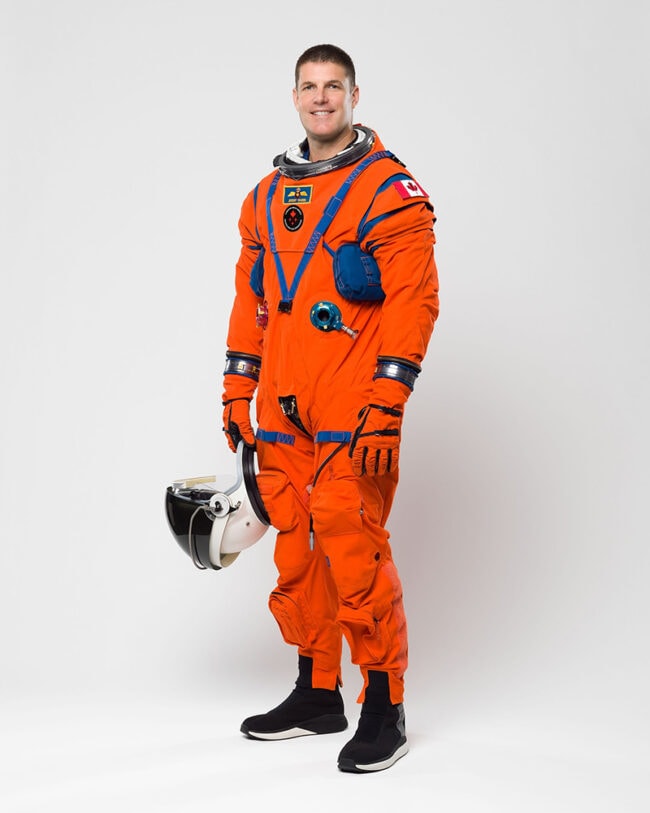
lead photo Artemis II Mission Specialist Jeremy Hansen, CSA (Canadian Space Agency) March 27, 2026, at the Launch and Landing Facility at the agency’s Kennedy Space Center in Florida in preparation for the Artemis II test flight. Hansen, and NASA astronauts Commander Reid Wiseman, Pilot Victor Glover, and Mission Specialist Christina Koch will launch on a 10-day journey around the Moon and back aboard the agency’s SLS (Space Launch System) rocket and Orion spacecraft from Launch Complex 39B no earlier than 6:24 p.m. EDT on Wednesday, April 1. Courtesy NASA
Image Credit: NASA/Kim Shiflett
Other articles from totimes.ca – otttimes.ca – mtltimes.ca
You must be logged in to post a comment.