

Your benefits booklet lists $500 a year for mental health care. A Toronto therapist quotes $180 a session. Before you book, there’s one thing those two numbers can’t tell you: how much your plan will pay for this appointment.
In Ontario, private psychotherapy with a Registered Psychotherapist is generally paid for through extended health benefits or out of pocket. To find out whether insurance will help, give your insurer the therapist’s exact professional designation, the type of appointment and the fee. Then ask how much the plan would reimburse and what you’ll need to submit.
Where to look for coverage
Start with your benefits booklet or your insurer’s member portal. Look under mental health, psychological services or paramedical benefits. As the Canadian Life and Health Insurance Association explains in Understanding Your Mental Health Benefits, the options available to you depend on your plan. If you have benefits through work and through a partner, check both before assuming they cover the same appointments.
An Ontario health card serves a different purpose. OHIP covers medically necessary physician care, including eligible care from a psychiatrist or family doctor. As CAMH explains in its guide to finding a psychotherapist, it generally does not pay for a private appointment with a Registered Psychotherapist. Publicly funded services and an Employee Assistance Program may offer other routes to care. Ask about eligibility and how to access them separately from your insurance claim.
Match the therapist and the appointment to your plan
Ask the clinic for the name, designation and registration number of the person you would actually see. Your plan may list a Registered Psychotherapist (RP), Registered Social Worker (RSW) or psychologist under different rules. If it lists psychologists but says nothing about psychotherapists, ask your insurer to confirm eligibility before relying on that benefit.
Check the appointment as well as the practitioner. If you’re considering art therapy in Toronto, ask the clinic how the session and the clinician’s designation will appear on the receipt. Use those details to confirm coverage. For a couples or virtual appointment, ask whether that specific format is eligible and whose benefit would apply.
If the designation is RP (Qualifying), give your insurer the full title. The College of Registered Psychotherapists of Ontario (CRPO) notes that some insurers ask for proof of supervision. The receipt must still identify the person who provided the service. Ask what documentation the insurer needs and whether the clinic can provide it.
Work out what you’ll actually pay
A plan that reimburses 80% may apply that percentage to an eligible fee lower than the clinic’s price. Ask for these figures together:
- Session price: the clinic’s total charge for the appointment you’re considering.
- Eligible amount and reimbursement: the amount the insurer will use for the calculation, the percentage it will pay and any separate payment cap per visit.
- Deductible: any amount you still have to pay before your plan starts reimbursing eligible expenses.
- Remaining benefit: how much is left, whether other practitioners share that limit and when the benefit year resets.
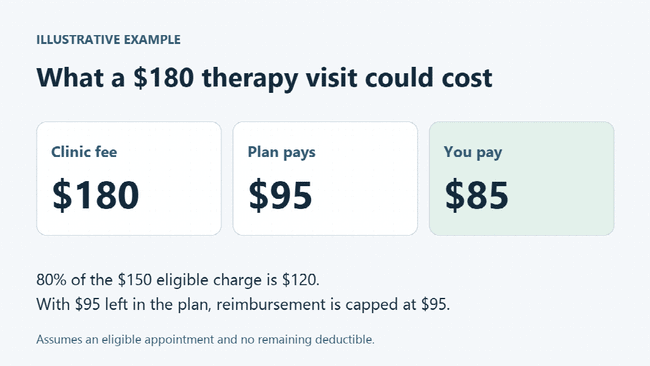
A worked example: Suppose a session costs $180, your plan counts up to $150 of that charge as eligible, and it pays 80% of the eligible amount. With no deductible left, the calculation gives $120. If you have only $95 of coverage remaining, the plan would pay $95 in this example and you would pay $85. Once that balance is used, you could owe the full $180 for your next visit. The figures are illustrative; ask your insurer to run the calculation using your plan and the quoted fee.
Send one specific question before booking
Save time by putting the practitioner, appointment and price in one message through your insurer’s secure portal:
I’m considering a [service and format] appointment in Ontario with [name, professional designation and registration number]. The clinic quoted $[fee]. Is this appointment eligible under my plan? What would you reimburse given my remaining balance, and do I need a referral or any specific information on the receipt? Please also confirm my claim deadline.
Save the reply with the clinic’s fee quote. If you’re comparing providers, you can ask the intake team at Therapedia Centre for the proposed therapist’s designation, fee and receipt details. Your insurer confirms what your plan will pay.
Submit the claim and check the response
Ask whether the clinic can submit the claim for your particular plan. With direct billing, the clinic submits it and you may still owe a balance. If you submit it yourself, you usually pay the clinic, keep the receipt and send it using the insurer’s instructions. Canada Life’s claims guide, for example, explains how to attach a receipt through its member portal. Check your own plan’s deadline and required documents.
Before submitting, confirm the receipt shows the correct service date, fee, client and practitioner details. If the claim comes back unpaid or lower than expected, read the explanation of benefits. A missing registration number calls for a different next step than an exhausted benefit or an ineligible appointment. Ask the insurer what can be corrected or reviewed, and ask the clinic for a corrected receipt only if the original contains an error.
Questions that can affect the cost
A few plan details are easy to miss, especially if you’re booking for the first time or changing providers.
Do I need a doctor’s referral?
Ask about the claim separately from booking. A clinic may let you book directly while your insurer requires a referral for reimbursement. If one is required, confirm when you need it.
The date on a receipt can also matter when you have a new plan or your benefits are about to renew.
Which benefit year will the claim count toward?
Give the insurer your intended service date and ask which balance applies. The benefit year and the deadline to file a claim are separate details; confirm both.
Ask the clinic for a total fee so you’re comparing the actual amount due.
Will the session fee include HST?
The Canada Revenue Agency’s April 2026 guidance explains that eligible psychotherapy and counselling therapy services have been exempt from GST/HST since June 20, 2024. The exemption depends on the service and practitioner. Confirm the total for your specific appointment.
contributed post













You must be logged in to post a comment.