

Many travelers only discover after buying an esim card that it does not come with a new phone number. That can sound like a serious limitation, especially if you are used to physical SIM cards that include data, calls, and SMS together.
For most international trips, however, a data-only eSIM can still cover the things you use most: maps, WhatsApp, email, ride-hailing, translation apps, browsing, and internet-based calls. All of these depend on mobile data rather than a new local phone number.
The phone-number question matters in more specific situations—such as receiving regular SMS, making carrier calls, getting bank verification codes on your usual number, or using a local service that requires a domestic number. Knowing which of those situations applies to your trip makes it much easier to decide whether a data-only travel eSIM is enough.
A Travel Data Plan Can Work Without Giving You a New Number
A data-only eSIM has a narrow job: move internet traffic.
It does not automatically provide a number that another person can dial, and it cannot receive an ordinary SMS sent to a new local number if no such number exists. That may sound like a major limitation until you look at what a traveler actually does with a phone during an ordinary day abroad.
Opening Google Maps does not require a new number. Neither does checking a flight, opening a train ticket, searching for a restaurant, translating a menu, sending an email, uploading a photo, or booking a ride from an account that is already set up.
Even many calls now happen inside apps rather than through the mobile carrier.
The practical question is therefore not “Does this eSIM have a number?” but “Which things on my itinerary actually require one?”
Will WhatsApp, FaceTime, Maps, and Ride Apps Still Work?
Usually, yes, because these services use data.
WhatsApp is a useful example. The account may have been registered with your normal phone number, but everyday messages and WhatsApp calls travel over an internet connection. Installing a data-only travel eSIM does not automatically create a new WhatsApp identity or force you to tell all your contacts that your number has changed.
The same general distinction applies to services such as Telegram, FaceTime, email, maps, browsers, and many travel apps. They need a working internet connection; they do not need the travel eSIM itself to have a conventional mobile number.
Ride-hailing deserves one qualification. An existing account may work perfectly over travel data, but account creation, recovery, or an unusual login can sometimes trigger phone-number verification. That requirement comes from the app, not from the eSIM.
Preparing important travel apps before departure reduces the chance of discovering an SMS requirement when the home line is difficult to access.
What About Bank Codes and Ordinary SMS?
This is where the distinction matters most.
A data-only travel eSIM cannot receive an SMS addressed to a phone number it does not have. If your bank sends a security code to your usual number, that code belongs to the home line, not the travel-data line.
On a compatible dual-SIM phone, travelers can often leave the normal SIM active for calls and SMS while assigning mobile data to the travel eSIM. Whether receiving a text or answering a call costs money depends on the home carrier’s international rules, so those charges should be checked before departure.
It is also worth reviewing which important accounts still depend on SMS. Some banks and services offer approval through their own app or an authenticator instead. Setting that up at home can reduce dependence on mobile text messages while traveling.
A bank code sent to your existing number and a local restaurant asking for a destination-country phone number are two different problems. One may be solved by keeping the home line reachable; the other may genuinely require a local number.
The Missing Number Matters When a Local Service Insists on One
A tourist can go days without needing a local number and then encounter one form that insists on it.
A restaurant reservation system, delivery service, clinic, landlord, employer, or another local service may ask for a domestic number or send an SMS to confirm a booking. Requirements vary by country and service, so it is risky to assume either that every traveler needs a local number or that nobody does.
This is one reason the question is more important for some trips than others.
A traveler spending five days sightseeing and communicating mainly through internet apps may never need a local number. Someone staying for two months, renting an apartment, working locally, arranging frequent deliveries, or registering for destination-specific services may encounter local-number requirements repeatedly.
In that situation, a local carrier SIM/eSIM or another product that explicitly includes voice and SMS may be a better fit than trying to force a data-only product to perform a job it was never sold to do.
Keep Internet Calling Separate From Carrier Calling
“No phone number” does not mean “no way to call anyone.”
WhatsApp calls, FaceTime, Telegram calls, Google Meet, Zoom, and other internet calling services use data. If the other person or business can be reached through one of those services, the travel eSIM can supply the connection.
A conventional call from the phone dialer is different. That uses a carrier voice service. A data-only eSIM does not become a voice plan simply because the phone also contains a dialer.
This distinction is especially useful when thinking about hotels and restaurants. Many can be contacted through apps, email, booking platforms, or internet calling, but some still expect a normal phone call.
If traditional local calling is important to the trip, check for that requirement before buying rather than assuming every eSIM includes it.
Why a Data-Only eSIM Can Be a Better Fit for Everyday Travel
For travelers who mainly need maps, messaging, bookings, translation tools, browsing, and internet-based calls, a new local phone number often adds little value. What matters more is having reliable mobile data without changing the number already linked to family, banks, work accounts, and messaging apps.
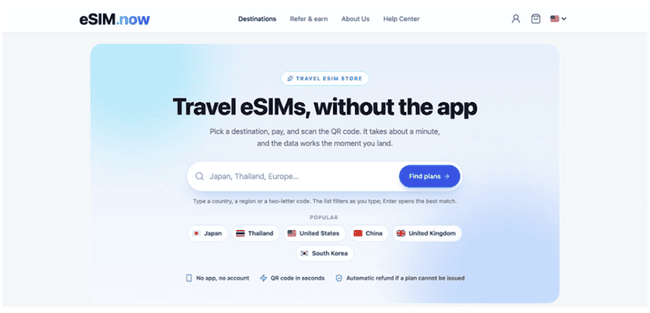
That is where a service such as esimnow can fit naturally into the trip. Its travel eSIMs are data-only, so the existing phone number stays on the primary SIM while the eSIM handles mobile data. On a compatible dual-SIM device, travelers do not need to remove their usual SIM simply to get online abroad.
The buying process is also designed around short-term travel rather than a traditional mobile contract. Users can compare destination coverage, data allowance, validity, activation conditions, and any plan-specific restrictions before purchase. Country-specific, regional, and global options are available, so the plan can be matched to a single destination or a wider itinerary.
There is no mandatory app or account required at checkout. After payment, the eSIM and QR code are delivered electronically through the order page and email. Travelers can install the profile over Wi-Fi before departure, and current plans state that service begins when the eSIM first connects to a supported network at the destination.
For someone who does not actually need a new local number, that setup keeps the trip simpler: the familiar number remains where it is, while the travel eSIM adds the data connection needed abroad.
A Local Number Is a Separate Travel Requirement
It helps to stop treating “mobile service” as one indivisible product.
A traveler may need international data, access to a home number, and a destination-local number—or only one or two of those things.
Travel data answers the question “How will my phone get online?” Your existing SIM answers “How can people still reach the number I already use?” A local voice/SMS plan answers “How can a service in this country call or text me on a domestic number?”
Those needs can overlap, but they are not identical.
If your itinerary includes a service that explicitly requires a local number, solve that requirement directly. Buying more gigabytes will not create one.
If nothing on the trip requires local carrier voice or SMS, a data-only eSIM may already provide the connectivity that matters.
Know What You Need the Number For
The absence of a phone number on a travel eSIM is neither automatically a disadvantage nor something to ignore.
For ordinary tourism, mobile data handles a large share of daily needs. Messaging, navigation, reservations, email, translation, social media, and internet calls can all work without the travel line receiving a new local number.
The decision changes when a real task depends on ordinary SMS or a domestic phone number.
Before buying, think through the trip rather than the product label. Will you need bank codes on your existing number? Will a local service insist on a local number? Will you make normal carrier calls, or will app-based communication be enough?
Once you can name the job the number needs to perform, it becomes much easier to decide whether a data-only travel eSIM is enough or whether the trip needs an additional phone service.
contributed post
lead photo by Opal Pierce on Unsplash














You must be logged in to post a comment.