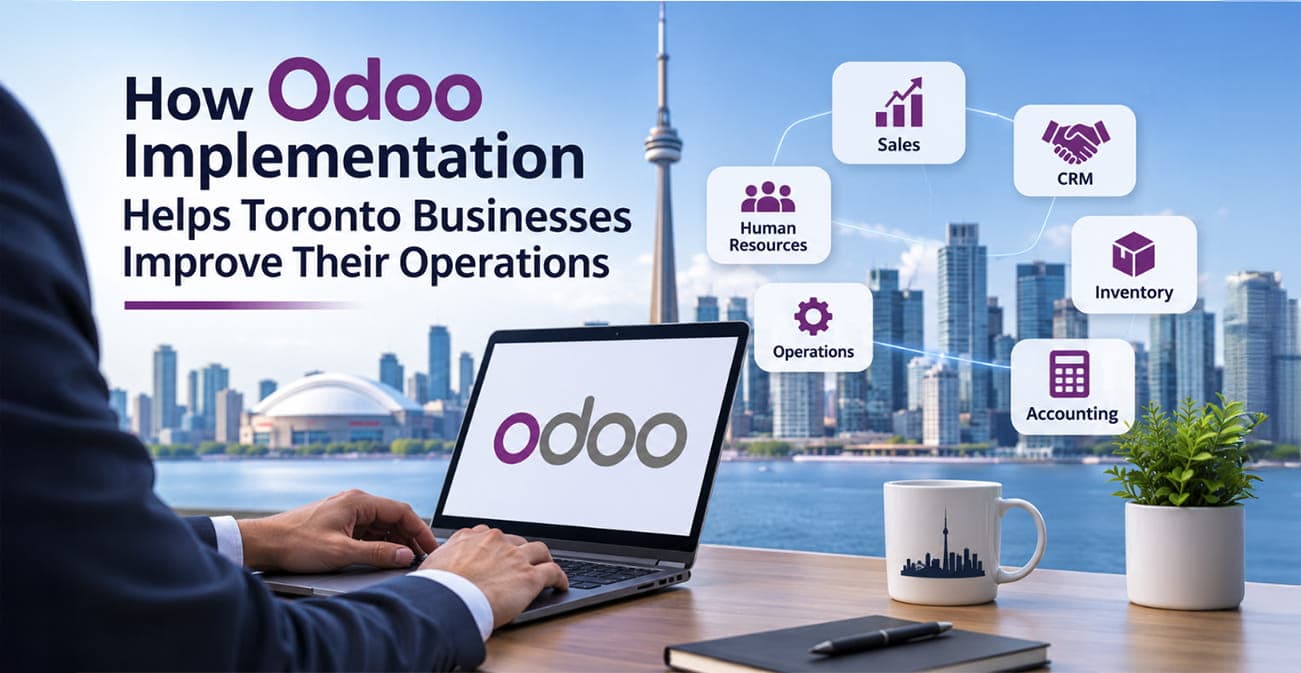
Managing business operations becomes increasingly complicated as a company grows. Sales, accounting, inventory, customer relationships, purchasing, and human resources all require attention. When these departments rely on separate software systems, keeping information organized and maintaining consistent workflows can become difficult. This is one reason many companies are considering integrated enterprise resource planning solutions.
For businesses operating in Toronto, Odoo implementation offers an opportunity to bring different business functions together through a single platform. Rather than managing several disconnected applications, companies can use Odoo to coordinate their daily activities, access shared information, and improve communication between departments.
However, implementing an ERP system involves more than installing software. Businesses need to evaluate their existing processes, select suitable modules, configure the platform, migrate information, and prepare employees for the transition. A well-planned implementation can help companies establish a more organized technology environment that supports their current operations and future growth.
Why Toronto Businesses Are Considering Odoo ERP
Toronto has a diverse business environment that includes professional service providers, retailers, manufacturers, wholesalers, technology companies, and growing startups. Each industry has different operational requirements, but many organizations face similar challenges when managing information across multiple departments.
For example, a retailer may use one application for inventory, another for accounting, and a separate platform for customer information. A manufacturing company may struggle to coordinate purchasing, production schedules, warehouse operations, and sales orders.
These disconnected systems can create unnecessary administrative work. Employees may need to enter the same information several times, while managers have to collect reports from different sources before making decisions.
Odoo provides an integrated ERP environment that allows businesses to manage several functions within one system. Depending on their requirements, companies can implement applications for accounting, CRM, sales, inventory, manufacturing, purchasing, human resources, and project management.
For organizations exploring Odoo implementation in Toronto, the main question is whether the platform can support their existing business model while providing room for future development.
What Does Odoo Implementation Involve?
Odoo implementation is the process of configuring and deploying the ERP platform according to a company’s operational requirements. The project typically includes several stages, each contributing to the stability and usefulness of the final system.
Business Requirements Assessment
The first stage involves reviewing how the company currently operates. Consultants examine existing software, departmental responsibilities, reporting requirements, approval procedures, and recurring administrative tasks.
This assessment helps identify areas where Odoo can provide practical improvements.
For instance, a distribution company may need better coordination between sales orders and warehouse inventory. A professional services business may prioritize CRM, project management, invoicing, and employee timesheets.
Without this initial assessment, companies risk purchasing or configuring modules they do not actually need.
Module Selection and Configuration
Odoo offers different applications that can be activated according to business requirements. Selecting the right combination is an important part of the implementation process.
A company focused on sales and customer relationships may begin with CRM, Sales, and Invoicing. A manufacturing organization may require Inventory, Manufacturing, Purchase, and Quality applications.
Configuration involves adjusting system settings, user permissions, workflows, automated actions, and reporting options.
The objective is to make the platform reflect how the business operates without introducing unnecessary complexity.
Data Migration
Existing business information must be transferred into the new ERP environment. This may include customer records, supplier details, product information, inventory quantities, historical transactions, and financial records.
Data migration requires careful preparation. Duplicate entries, inconsistent formatting, outdated records, and missing information should be addressed before importing data into Odoo.
Businesses should also validate migrated records to confirm that important information remains accurate.
Testing and Employee Training
Before the system becomes part of daily operations, its major workflows should be tested.
Employees should be able to complete common tasks such as creating quotations, processing orders, updating inventory, issuing invoices, and generating reports.
Training is equally important. Even a properly configured ERP system may deliver limited results if employees do not understand how to use it.
Practical training sessions based on actual job responsibilities can make the transition easier.
Key Benefits of Odoo ERP for Local Businesses
One of the main reasons organizations consider Odoo is its modular structure. Businesses can begin with the applications they need and expand their ERP environment as requirements change.
Centralized Business Information
When departments use disconnected applications, information often becomes fragmented. Sales teams may have limited visibility into inventory, while accounting employees may need to request transaction details from other departments.
Odoo connects different business functions through shared information. This can reduce repetitive data entry and help employees access relevant records without switching between multiple platforms.
Centralized information also gives management a more consistent view of business activities.
Better Inventory Management
Inventory management is particularly important for retailers, distributors, and manufacturers.
Odoo Inventory supports stock tracking, warehouse operations, product movements, replenishment rules, and other warehouse activities.
Businesses can monitor available quantities and coordinate inventory movements with sales and purchasing activities.
For companies managing multiple warehouses or a large product catalogue, properly configured inventory workflows can reduce manual administrative work and improve stock visibility.
Improved Customer Relationship Management
Customer information is valuable across the entire sales process. When contact records, communication history, quotations, and sales opportunities are stored separately, employees may struggle to maintain a consistent customer experience.
Odoo CRM provides tools for managing leads, opportunities, activities, and sales pipelines.
Sales representatives can track customer interactions and monitor opportunities from initial contact through the closing stage.
This can help management review sales performance and identify opportunities that require additional attention.
More Organized Accounting Processes
Financial management is another important consideration when selecting an ERP platform.
Odoo Accounting supports invoicing, payments, reconciliation, financial reporting, and other accounting activities. Its integration with sales and purchasing applications can reduce the need to transfer transaction information manually.
Canadian businesses should pay particular attention to tax configuration, GST/HST requirements, reporting needs, and applicable accounting practices during implementation.
A qualified implementation team should confirm that the configuration meets the company’s specific financial and regulatory requirements.
Support for Business Expansion
A company may initially require only CRM and invoicing, but its requirements can change as it hires employees, opens additional locations, or expands its product range.
Odoo’s modular structure allows organizations to introduce additional applications as their needs develop.
This makes it possible to approach ERP implementation in stages rather than attempting to replace every existing business system at once.
Choosing the Right Odoo Implementation Services in Toronto
Selecting an implementation provider is an important decision because the quality of the deployment can affect business operations for years.
Companies evaluating Odoo implementation services in Toronto should look beyond the initial project quotation. A lower implementation cost does not necessarily represent better value if the project lacks proper planning, testing, or post-launch support.
Experience with similar business requirements is one factor worth considering. A provider familiar with retail operations may have different expertise from one specializing in manufacturing or professional services.
Businesses should also evaluate the provider’s technical capabilities. Some projects require standard configuration, while others involve custom modules, third-party integrations, or specialized reporting.
Communication is another important consideration. Implementation teams should explain technical decisions in understandable terms and provide realistic project timelines.
Before selecting an Odoo ERP consultant in Toronto, businesses can ask about previous projects, data migration procedures, employee training, documentation, and ongoing maintenance arrangements.
Odoo Customization and Third-Party Integrations
Although Odoo provides many standard applications, some organizations have requirements that cannot be addressed through default settings alone.
For example, an eCommerce company may need an integration between Odoo and its online store. A distributor may require a connection with a shipping provider, while a manufacturing business may need specialized production reports.
Odoo customization can address these requirements through additional fields, custom modules, automated workflows, and integrations with external applications.
However, customization should be approached carefully.
Adding too many modifications can increase maintenance requirements and make future upgrades more complicated. Businesses should first determine whether existing Odoo functionality or configuration options can address the requirement.
Custom development is most useful when it solves a clearly identified operational problem that cannot be handled effectively through standard features.
Common Challenges During ERP Implementation
ERP projects can face difficulties when businesses underestimate the preparation required before deployment.
One common problem is unclear project scope. When requirements are not documented properly, additional features and changes can extend implementation timelines and increase costs.
Poor data quality is another frequent issue. Importing inaccurate customer, product, or financial records can create problems that affect several departments.
Employee resistance can also slow adoption. People who are comfortable with existing software may hesitate to change their routines, particularly when the new system introduces unfamiliar processes.
These challenges can be addressed through clear project planning, realistic timelines, proper data preparation, employee involvement, and ongoing technical support.
Businesses should also avoid activating every available application immediately. A phased rollout can allow teams to become comfortable with core functions before additional modules are introduced.
How OERP Can Support Your Odoo Implementation Plans
Businesses looking for professional ERP assistance should consider the importance of working with a provider that understands both the technical and operational aspects of implementation.
OERP Canada has been an Odoo Gold Partner since 2018 and has delivered more than 200 Odoo projects across North America. Its services include Odoo implementation, upgrades, and project rescue. Companies should still assess its relevant experience and ongoing support arrangements before deciding whether it is suitable for their project.
The right provider should be able to translate business requirements into practical system configurations rather than simply installing software.
A successful engagement should also include clear communication, project documentation, testing procedures, and a defined approach to handling issues after deployment.
How Much Does Odoo Implementation Cost in Toronto?
The cost of Odoo implementation in Toronto depends on the size and complexity of the project.
A small company implementing a few standard applications may require considerably less work than a manufacturer operating several warehouses with customized production processes.
Several factors influence the overall budget:
- Number of Odoo applications required.
- Complexity of existing business workflows.
- Volume and condition of data being migrated.
- Custom development requirements.
- Third-party software integrations.
- Number of employees requiring training.
- Hosting, maintenance, and ongoing support arrangements.
Businesses should request a project assessment before committing to a budget. A detailed proposal should explain the expected deliverables, implementation stages, estimated timeline, and any additional costs.
It is also important to consider long-term expenses such as software subscriptions, hosting, maintenance, and future development.
Final Thoughts
Odoo can provide Toronto businesses with a centralized platform for managing sales, accounting, inventory, customer relationships, manufacturing, and other operational activities.
However, the value of an ERP system depends heavily on how well it is implemented. Proper requirements assessment, module selection, data migration, employee training, and ongoing support all contribute to a successful deployment.
Companies considering Odoo implementation in Toronto should begin by identifying their operational challenges and determining which processes would benefit most from integration.
With a realistic project scope and a capable implementation provider, businesses can establish an ERP environment that supports more organized operations, better information management, and sustainable growth.
contributed post