
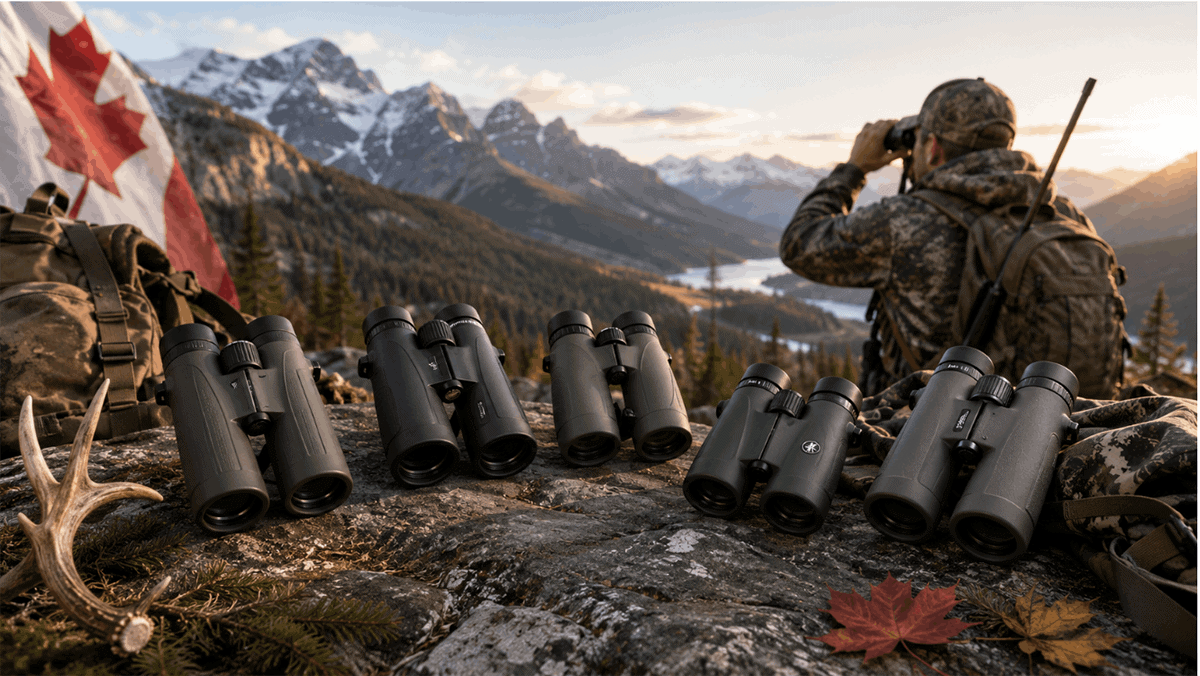
A quality pair of binoculars is one of the most underrated pieces of equipment in a Canadian hunter’s kit. Glassing a hillside for hours before a single rifle shot is fired is standard practice for mule deer, elk, and moose hunters across Alberta, British Columbia, and northern Ontario — and the binoculars you carry determine whether you spot game at all. This guide breaks down magnification, objective lens size, and the specific models Canadian hunters should consider in 2026, from budget-friendly options to premium glass.
Quick Answer: For most Canadian big game hunters, an 8×42 binocular offers the best balance of field of view, low-light performance, and stability for forest and mixed terrain. Hunters in open country — Alberta prairie, BC alpine — benefit from a 10×42 for additional reach. The Vortex Diamondback HD 10×42 ($350–$400 CAD) is the top all-round value pick; the Vortex Viper HD 10×42 ($700–$750 CAD) is the best step-up for serious hunters wanting ED glass clarity.
Key Facts: 8×42 binoculars provide a wider field of view (~345+ ft at 1000 yards) than 10×42 (~315 ft) — easier to track moving game• A larger objective lens (42mm) gathers significantly more light than a 32mm lens — critical for dawn/dusk hunting when game is most active• Vortex Diamondback HD retails $350–$400 CAD in Canada; Viper HD retails $700–$750 CAD (2026 Canadian retail pricing)• ED (Extra-low Dispersion) glass reduces chromatic aberration — the colour fringing visible on higher-end optics in low light
8×42 vs 10×42 — Which Magnification Should Canadian Hunters Choose?
This is the single most common question Canadian hunters ask when buying their first quality binocular, and the answer depends entirely on your hunting terrain and target species.
8×42 — Best for Bush, Forest, and Close-to-Medium Range
An 8×42 binocular magnifies the image 8 times through a 42mm objective lens. The wider field of view of an 8×42 — typically 345+ feet at 1,000 yards — makes it significantly easier to track moving game through dense cover, which is exactly the scenario Ontario, Quebec, and Maritime whitetail hunters face most often. The lower magnification is also more stable when hand-held for extended glassing sessions, reducing the shake that becomes increasingly noticeable at 10x and higher.
10×42 — Best for Open Country and Longer Distances
A 10×42 binocular brings distant game noticeably closer, which matters significantly when glassing Alberta prairie for pronghorn and mule deer, or BC alpine slopes for mountain goat and sheep. The narrower field of view (approximately 315 feet at 1,000 yards) is the tradeoff — locating game initially is slightly harder, but identifying antler size or confirming species at distance is considerably easier.
12x and Higher — Specialist Glassing
Magnifications above 10x are typically reserved for dedicated glassing specialists — hunters who spend entire days picking apart distant hillsides for mule deer or sheep. At 12x and beyond, hand-held stability becomes genuinely difficult without support, and most serious users pair high-magnification binoculars with a tripod adapter for extended sessions.
Why Objective Lens Size Matters for Canadian Hunting Conditions
The second number in a binocular specification (the ’42’ in 8×42) is the objective lens diameter in millimetres. This number determines how much light the binocular gathers — directly affecting how clearly you can see in the low-light conditions when most Canadian big game is active.
Deer, elk, and moose are most active during the first and last 30–45 minutes of legal hunting light — precisely when a smaller 32mm or 28mm lens struggles to deliver a bright, clear image. A 42mm objective lens is the practical minimum for serious Canadian hunting applications; anything smaller compromises low-light performance exactly when you need it most.
Exit Pupil — The Number Most Buyers Miss
Exit pupil (objective lens diameter divided by magnification) determines how bright the image appears to your eye. An 8×42 binocular has a 5.25mm exit pupil; a 10×42 has a 4.2mm exit pupil. The human eye’s pupil dilates to roughly 5–7mm in low light — meaning an 8×42 delivers a noticeably brighter image at dawn and dusk than a 10×42 with the same objective lens size.
ED Glass, Coatings, and Why Optical Quality Costs Money
Two binoculars with identical specifications (8×42) can perform dramatically differently based on glass quality and lens coatings. Understanding these differences explains why binocular prices range from $150 to $3,000+ CAD for the same nominal specification.
Extra-low Dispersion (ED) Glass
ED glass reduces chromatic aberration — the purple or green colour fringing visible around high-contrast edges, particularly noticeable in low light. Standard glass binoculars show this fringing readily; ED glass models from the Vortex Viper HD tier and above largely eliminate it, delivering noticeably crisper images especially in challenging light.
Fully Multi-Coated Lenses
Quality hunting binoculars use fully multi-coated lenses — meaning every glass surface, not just the outer lens, receives anti-reflective coating. This maximises light transmission through the optical system. Budget binoculars often coat only the outer surfaces, leaving internal light loss that reduces overall brightness.
Phase-Corrected Prisms and Dielectric Coatings
Roof prism binoculars (the standard compact design) require phase correction coating to prevent image dulling. Dielectric mirror coatings on the prism surfaces further improve light transmission and colour accuracy. These features appear on mid-tier and above models like the Vortex Diamondback HD and represent a meaningful step up from entry-level optics.
Top Binoculars for Canadian Hunters in 2026
| Model | Magnification | CAD Price | Glass | Best For |
| Vortex Crossfire HD 8×42 | 8x | ~$230 | Standard HD | Budget-conscious bush hunter |
| Vortex Diamondback HD 10×42 | 10x | ~$370 | HD coated | Best all-round value |
| Vortex Diamondback HD 8×42 | 8x | ~$350 | HD coated | Bush/forest whitetail hunting |
| Vortex Viper HD 8×42 | 8x | ~$740 | ED glass | Premium low-light performance |
| Vortex Viper HD 10×42 | 10x | ~$750 | ED glass | Premium open-country glassing |
| Vortex Diamondback HD 15×56 | 15x | ~$500 | HD coated | Long-range alpine/prairie glassing |
Vortex Crossfire HD 8×42 — Best Budget Option (~$230 CAD)
The Crossfire HD delivers fully multi-coated optics, a waterproof and fogproof rubber-armoured body, and a wide field of view in Vortex’s entry tier. For a hunter buying their first quality binocular, or as a backup pair kept in the truck, the Crossfire HD punches well above its price point and carries Vortex’s unconditional lifetime warranty.
Vortex Diamondback HD 10×42 — Best All-Round Value (~$370 CAD)
The Diamondback HD is the single most popular hunting binocular among Canadian Vortex retailers for good reason. It uses Vortex’s HD Optical System with select glass elements, ArmorTek lens coating for scratch and oil resistance, and phase-corrected, dielectric-coated prisms — features typically reserved for more expensive tiers. Most serious Canadian hunters who are not yet ready for ED glass pricing land on the Diamondback HD as their long-term binocular. It includes the GlassPak harness system, keeping the binoculars accessible without a traditional neck strap.
Vortex Viper HD 10×42 — Best Premium Step-Up (~$750 CAD)
The Viper HD introduces true ED glass to meaningfully reduce chromatic aberration, delivering visibly sharper resolution and more accurate colour rendition than the Diamondback HD tier. For Alberta and BC hunters who spend hours glassing distant hillsides each season, the clarity improvement at dawn and dusk justifies the price difference for many serious hunters.
Vortex Diamondback HD 15×56 — Best for Extended Range Glassing
For mountain hunters in BC and Alberta who specifically glass for mule deer, sheep, or mountain goat across long distances, the 15×56 configuration trades portability for raw reach. At this magnification, a tripod adapter is strongly recommended for extended glassing sessions — hand-holding 15x for more than a few minutes becomes genuinely fatiguing.
Choosing Binoculars by Canadian Hunting Region
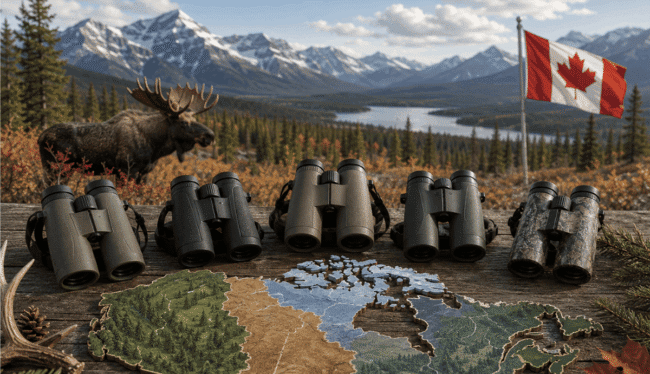
Ontario and Quebec — Bush and Mixed Forest
Ontario and Quebec whitetail hunters typically glass at 50–250 metres through bush and mixed forest. An 8×42 is the ideal magnification here — the wider field of view helps locate deer moving through cover, and the lower magnification is more forgiving of hand-shake when glassing from a tree stand. See our guide on the best province for deer hunting for region-specific hunting strategy across Canada.
Alberta and Saskatchewan — Open Prairie
Prairie hunters glassing for mule deer, pronghorn, and elk across open agricultural land benefit significantly from a 10×42 binocular’s additional reach. Heat shimmer (mirage) across open prairie in the warmer hunting months can also reduce effective glassing distance — a quality optic with good contrast handles this better than a budget option.
British Columbia — Mountain and Alpine Terrain
BC mountain hunters pursuing mule deer, mountain goat, and sheep across alpine terrain are the segment most likely to justify a 10×42 or even 15×56 configuration paired with a tripod. Glassing sessions here regularly run several hours at a single vantage point, making ED glass clarity and reduced eye fatigue genuinely valuable rather than a luxury upgrade.
Binoculars vs Rifle Scope — Why You Need Both
A common mistake among newer Canadian hunters is relying solely on a rifle scope for glassing terrain — using the rifle itself to scan for game. This is both unsafe (pointing a rifle at unconfirmed targets) and tactically inferior, since most rifle scopes have a narrower field of view and lower light transmission than dedicated binoculars at comparable magnification. Binoculars and a quality rifle scope serve distinct, complementary roles — spot with binoculars, then confirm and shoot through your scope. See our guide on choosing the best rifle scope for Canadian hunting applications to complete your optics system.
Care and Maintenance for Canadian Weather Conditions
- Confirm your binoculars are both waterproof and fogproof (argon or nitrogen purged) — essential for Canadian rain, snow, and temperature swings
- Store binoculars at room temperature before a cold-weather hunt to reduce internal fogging when moving between temperatures
- Clean lenses only with a proper optical cloth — using a sleeve or glove can introduce scratches that degrade clarity permanently
- Use the included rain guard and objective lens covers during transport to protect against scratches and moisture
- Check rubber armour periodically for tears that could allow moisture ingress, particularly after a hard fall or impact
Where to Buy Quality Hunting Binoculars in Canada
Victory Ridge Sports in Barrie, Ontario carries a curated range of Vortex binoculars suited to every Canadian hunting application — from the budget-friendly Crossfire HD through to ED-glass Viper HD models for serious glassing. Combine your binoculars with quality optics on your rifle and a reliable bolt action rifle for a complete Canadian hunting setup.
For most Canadian hunters, the Vortex Diamondback HD in either 8×42 (bush hunting) or 10×42 (open country) represents the best balance of price and performance available in 2026. Hunters who spend extended hours glassing distant terrain each season will find the step up to Viper HD ED glass clearly justified by reduced eye fatigue and improved low-light clarity.
Frequently Asked Questions — Hunting Binoculars in Canada
| Q: What magnification binoculars are best for deer hunting in Canada? |
| A: An 8×42 binocular is best for most Canadian deer hunting, particularly in Ontario, Quebec, and Maritime bush terrain. The wider field of view makes it easier to spot and track moving deer through cover. Hunters in open prairie terrain in Alberta and Saskatchewan often prefer a 10×42 for the additional reach across longer sightlines. |
| Q: Is a more expensive binocular actually worth it for hunting? |
| A: Yes, for hunters who spend significant time glassing terrain. Higher-priced binoculars with ED glass and better coatings deliver noticeably clearer images in low light — exactly when most Canadian big game is active. For occasional hunters who glass for short periods, a mid-tier option like the Vortex Diamondback HD provides excellent value without the premium ED glass cost. |
| Q: What is the difference between Vortex Diamondback HD and Viper HD binoculars? |
| A: The Viper HD uses true ED (Extra-low Dispersion) glass elements that significantly reduce chromatic aberration and colour fringing, delivering sharper resolution especially in low light. The Diamondback HD uses Vortex’s standard HD Optical System with select glass elements but without true ED glass. The Viper HD typically costs roughly double the Diamondback HD in Canadian retail pricing. |
| Q: Are waterproof binoculars necessary for Canadian hunting? |
| A: Yes. Canadian hunting conditions regularly involve rain, snow, and significant temperature swings between dawn and midday. Waterproof, fogproof (nitrogen or argon-purged) binoculars prevent internal fogging and moisture damage that can permanently degrade a non-sealed optic over a single wet hunting season. |
| Q: Do I need a tripod for hunting binoculars? |
| A: A tripod is not necessary for 8×42 or 10×42 binoculars used for typical Canadian hunting glassing sessions of 20–30 minutes. For extended glassing at 12x magnification or higher — common among BC mountain hunters glassing for sheep or mountain goat across multiple hours — a tripod adapter significantly reduces eye fatigue and improves your ability to spot distant game. |








You must be logged in to post a comment.