
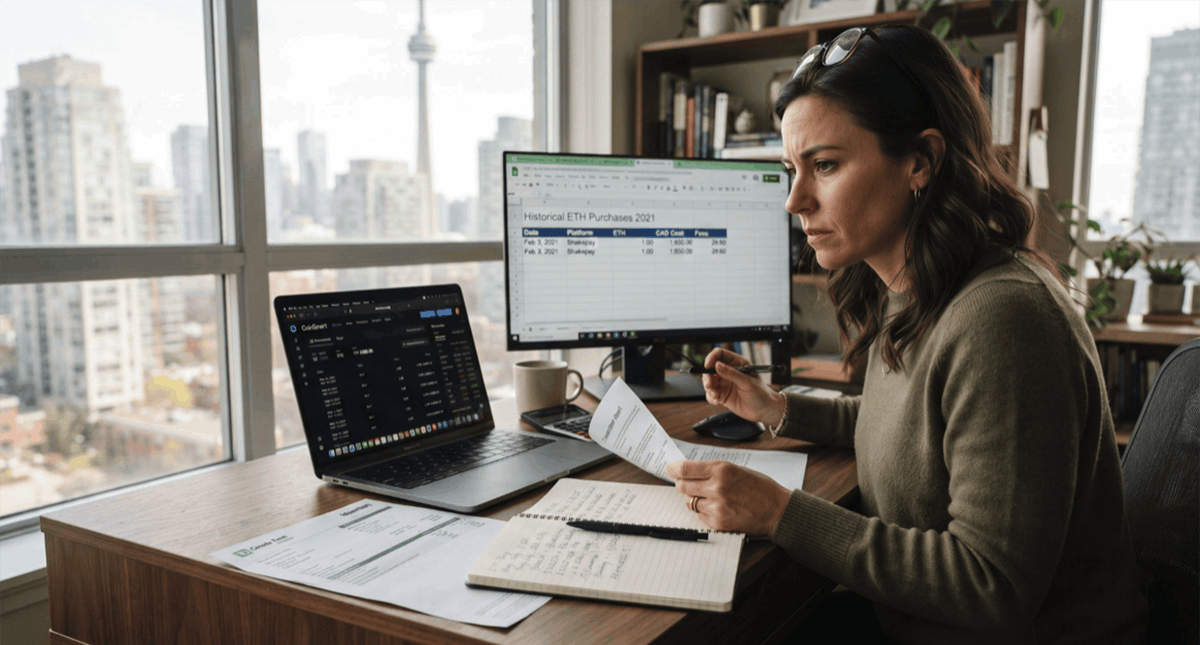
Imagine selling ether this year that you bought in 2021. The exchange where you sold it shows the date, the number of coins and the sale proceeds. Your bank statement shows the money arriving a few days later. Then your accountant asks what you originally paid. That figure is in a different account, on a platform you stopped using years ago.
That’s a good reason to spend a little time in an old crypto account before you close it. The Canada Revenue Agency expects Canadians who transact in crypto to keep records that explain their activity, including the type and number of units involved, the date and time, the Canadian-dollar value and the nature of each transaction. Some of that information may be spread across several downloads.
Here’s how to leave an exchange with records you can still make sense of years later.
Find out how far back the download goes
Start with a date you can verify. Search your email for the original account confirmation or check an old bank statement for your first deposit. That gives you a starting point when the exchange asks you to select a date range.
Suppose your first deposit was in November 2022, but the earliest entry in your download is January 2023. You’ve found a gap while you can still do something about it. Check the date filter, see whether the platform provides a separate archive for older activity and download each period you need. If the records are unavailable, ask support specifically for November and December 2022. Give them the date and amount of the deposit you can identify.
Open each file before moving on. A spreadsheet with column headings and no transactions can look like a successful download until you read it.
Get the trades and the transfers
An exchange may keep several histories under the same account. The trade history typically shows purchases, sales and swaps. The transfer history shows deposits and withdrawals, including movements to or from an external wallet. If you used other features, such as a rewards program, look for a separate activity statement for those entries as well.
To see why both histories matter, consider a Toronto investor who buys ether on one exchange, moves it to a personal wallet and later sends some of it to a second exchange to sell. The first exchange has the purchase details. The wallet records the movement between platforms. The second exchange has the sale. Each record answers a different question about the same holding.
A Canadian-dollar withdrawal to your bank is another part of that history. If you sold ether on Friday and transferred the cash to your chequing account on Monday, keep both entries. The Friday trade shows the sale price and quantity. The Monday bank deposit shows how much cash arrived. Months later, that distinction can save you from using the wrong date or mistaking a partial withdrawal for the full proceeds of a sale.

Read the currency column before trusting the total
A Canadian bank account can fund a trade that an exchange displays in US dollars. A crypto-to-crypto swap can appear without a dollar figure at all. When you open a trade export, check what the price column actually measures. Is it the price of one coin or the value of the entire trade? Which currency is it in? Does the fee appear separately?
These details matter because the CRA asks taxpayers to retain the value of their crypto transactions in Canadian dollars at the time each took place. If you calculate a Canadian-dollar figure in a spreadsheet, keep the exchange’s original file and record the rate and source you used. Someone reviewing the figure later should be able to follow how you arrived at it.
Check the time zone, too. An evening trade made in Toronto on December 31 can appear as January 1 in a file that uses Coordinated Universal Time (UTC). Keep the original timestamp and its time-zone label. That small detail can explain why a trade you remember making on New Year’s Eve appears in the following year’s export.
Label the wallets while you still recognize them
A transaction history might show that you sent crypto to a long string of letters and numbers. Two years from now, will you remember whether that address belonged to your personal wallet, another exchange account or someone you paid?
A simple wallet list can help. Record the public wallet address, a name you recognize and the approximate dates you used it. A note such as “personal wallet I used after moving my ether off the exchange in spring 2024” gives you something an address alone cannot. Keep passwords, private keys and recovery phrases out of your tax records.
If you find an outgoing transfer you cannot explain, mark it as unresolved. Save the date, amount, asset and transaction ID, along with any corresponding entry you can find. A specific question such as “Where did this March 14 withdrawal go?” is much easier to investigate than a year’s worth of unexplained activity. Toronto accounting firm Faris CPA helps taxpayers reconstruct trading histories when the records span exchanges and personal wallets.
Do one test before you close the account
Pick a transaction you actually remember. Perhaps it was your first bitcoin purchase or the time you moved ether into your own wallet. Using only the files you’ve downloaded, try to answer four questions:
- When did it happen?
- What asset and quantity were involved?
- What was it worth in Canadian dollars at the time, and where did that figure come from?
- If you moved it, can you identify the account or public wallet address on the other side?
If you get stuck, go back into the account and find the missing detail. It might be as simple as downloading a fee statement or changing a date filter. Once you can follow that transaction from start to finish, save the original exports and your notes together, with a secure backup. The best time to discover that an old exchange still holds a record you need is while you can still sign in.
contributed post















You must be logged in to post a comment.