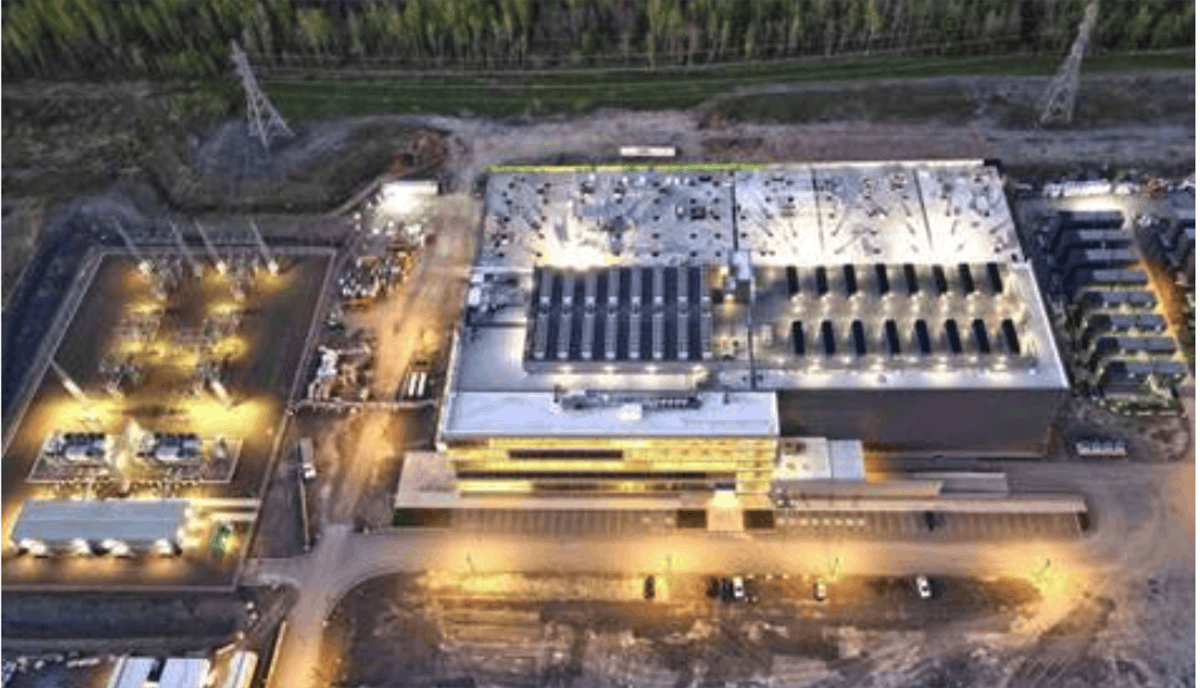
Four GTA councils have now voted on whether to allow these buildings. Almost nobody in those debates has described what is physically inside one.
On a Tuesday evening in August, Oakville council voted unanimously to freeze data centre development across the whole town for a year. At the time it had not received a single application to build one.
“A data centre could happen anywhere in Town,” Mayor Rob Burton told the meeting, adding that council was “operating here not out of fear, and not in reaction to any one application.” Three months earlier, Hive Digital Technologies had announced a 320-megawatt AI facility somewhere in the GTA, and the company had reportedly discussed a site in Oakville.
Mississauga had actually moved first, voting unanimously on 29 July to draft a freeze on anything above 10 megawatts, then enacting it on 16 September. The bylaw caught a 40-megawatt Prologis proposal on Tenth Line West. “Putting development before planning is never a good idea,” said Councillor Martin Reid, whose ward it is. Hamilton had gone the other way in July, voting 10 to 6 against a pause, to boos from the gallery. Toronto council took a third route in late July, directing staff to review its planning policies and asking Queen’s Park for a province-wide framework.
Premier Doug Ford, launching Ontario’s draft Data Centre Playbook in Guelph that August, called the municipal freezes NIMBYism. “I find it, I guess, hypocritical. That’s the word,” he said. “We’re going to use all the data, we’re going to use everything, but we aren’t going to put it in our backyard.”
Four councils, one draft provincial framework and a summer of public meetings later, the buildings themselves have gone largely undescribed.
Seven thousand megawatts
As of the Playbook launch on 13 August, roughly 7,000 megawatts of data centre connection requests were sitting in the queue at Ontario’s Independent Electricity System Operator, more than a quarter of the province’s peak demand of about 25,000 megawatts. In March the queue had been roughly half that size.
The STACK campus on the Danforth is listed at 56 megawatts and energized at eight. Compass in Etobicoke has 27 announced against 10 drawn; the 55H site in Brampton, 20 against three. A megawatt figure in a press release is a reservation, not a meter reading, and a lot of the public confusion sits in that gap.
The queue is still where the pressure is. The IESO’s 2026 planning outlook puts data centres at 8.6 per cent of all Ontario electricity demand by 2050, up about 60 per cent on its previous forecast, even as the agency trimmed its overall growth projection from 75 to 65 per cent. Data centres are claiming a bigger slice of a slightly smaller pie.
What a rack looks like now
For most of the last 25 years a rack of servers drew something like three kilowatts, creeping up to about ten. AI hardware broke that. Schneider Electric’s figures put an NVIDIA A100 rack at around 25 kilowatts in 2022, an H100 at 40 in 2023, a GH200 at 72 in 2024, and a GB200 at roughly 132 in 2025.
One GB200 rack weighs about 1,360 kilograms, roughly 3,000 pounds. It holds 72 GPUs and 36 CPUs, pulls around 120 kilowatts continuously through four 30-kilowatt shelves at 480 volts, and carries somewhere north of 5,000 individual connections (144 copper NVLink cables, 288 optical, 72 coolant tubes). It goes into position on a two-tonne hydraulic lift.
That weight has killed off a piece of data centre furniture that lasted half a century. A rack like that stands on less than a square metre of floor, so it puts somewhere between 1,500 and 1,900 kilograms per square metre through its feet, depending on configuration, and a standard raised floor, the kind with lift-out tiles and cabling running underneath, is rated for roughly 1,000. AI halls go on slab now, with the cabling overhead.
Most buildings are nowhere near this. In the Uptime Institute’s 2025 survey of more than 800 operators, few facilities reported any racks above 30 kilowatts.
Cooling, and the water nobody has measured
At 120 kilowatts a rack, air stops working. The heat goes into liquid pumped directly across the chips, roughly 200 litres per rack moving at 80 litres a minute and arriving at 20 to 25 degrees. Servicing one means flushing the loop three times over 12 to 16 hours before anybody opens it.
Ontario’s draft Playbook encourages closed-loop and waterless cooling, where the coolant circulates in a sealed circuit instead of evaporating off. How that preference would be enforced is not stated. There is also not much to measure it against. No public source gives a water consumption figure for any data centre operating in Ontario, and the Uptime survey found only 47 per cent of operators worldwide collect the data at all. Water comes up at every council meeting and nobody has put a number on it.
Why the neighbours complain in October
In Loudoun County, Virginia, which holds the largest concentration of data centres anywhere, officials have logged complaints from residents living more than three miles from a building. People describe a sound like a freight train that never arrives, and say it comes through the walls. There are active class actions in Michigan and Wisconsin.
The seasonal pattern is the part worth knowing here. Operators and residents report these facilities running relatively quietly above about 21 degrees and getting loudest near 10, which in Ontario covers a good half of the year. No measured reading at an Ontario property line has been published anywhere. Oakville’s study is meant to produce one.
The buildings are also close to empty. Google runs a 500-megawatt campus outside Kansas City with roughly 200 permanent staff, and a large facility might have three or four people on shift at any given hour. Most of the jobs in these proposals are construction jobs, and Prologis was straightforward about that in Mississauga, estimating about 790 construction jobs a year during the build and roughly 75 permanent jobs once the building opened.
The fire system, and the day it took down a stock exchange
The common claim is that these buildings cannot use water sprinklers. They can, and most of them do.
NFPA 75, the standard covering fire protection for IT equipment, permits sprinklers, gas, or both. What actually gets installed in a modern facility is a double-interlock pre-action system. The pipes sit dry and empty, and water only enters them once two independent things have happened, usually an air-sampling smoke detector triggering and then a sprinkler head fusing. The Uptime Institute recommends this for most data centres, and engineers working on new AI facilities report building them with pre-action water only, specifying fewer gas systems than they did a decade ago.
Gas has not disappeared. It protects the smaller enclosed rooms, the electrical and telecoms spaces, because a big hall moves too much air to hold a concentration long enough to matter. Four inert blends are recognised under NFPA 2001 and ISO 14520. IG-01 is pure argon, IG-100 pure nitrogen, IG-55 an even argon and nitrogen split, and IG-541 a mix of 52 per cent nitrogen, 40 per cent argon and 8 per cent carbon dioxide.
Almost every popular account has these working by displacing the oxygen, and that is not what the research shows. NIST’s cup-burner work found the dominant effect is thermal: the flooded atmosphere carries heat away faster than the flame can produce it. The giveaway is that the leftover oxygen at the moment of extinguishment differs by gas. In one set of measurements, argon put the flame out with about 13 per cent oxygen remaining, nitrogen at about 15.5. If displacement alone set the limit, those two numbers would be the same.
Argon also needs a higher concentration than nitrogen to put a fire out, roughly 37 to 43 per cent depending on the fuel and test, against the high 20s to low 30s for nitrogen, because it is monatomic and has a molar heat capacity of 20.8 joules per mole-kelvin against nitrogen’s 29. Each mole of it absorbs less heat. Of the common inert agents it is the least thermally efficient, and it gets used anyway because it is chemically inert, electrically non-conductive, leaves no residue, and has a global warming potential of zero, which counts for a great deal while HFC quotas tighten around the chemical agents.
These systems carry a documented risk of their own. On 18 April 2018 a suppression system discharged at a Digiplex facility in Väsby, outside Stockholm, in a module rented by Nasdaq. There was no fire. Gas leaving the nozzles at 200 bar produced a sustained scream in the kilohertz range, and the pressure wave damaged hard drives badly enough to take the Nasdaq Nordic exchange offline for most of a trading day. The nozzles had silencers fitted. They did not appear to work.
Research out of Michigan Tech later put numbers on the effect. Laptop-class drives begin degrading at sound pressure levels as low as 85 decibels at the frequencies they like least, enterprise drives at around 90, and sealed helium-filled drives hold out to about 120. The worst band runs from 4 to 10 kilohertz. Uptime’s own incident database logs 54 inert gas events, 15 of them accidental discharges, with technician error the leading cause by a wide margin.
Where the argon comes from
Argon makes up 0.93 per cent of the air in the room you are sitting in, and getting it out is harder than that sounds.
Air separation works by chilling air until its components boil off at different temperatures. Nitrogen boils at minus 195.8 degrees and oxygen at minus 183.0, thirteen degrees apart, which is a comfortable margin to work with. Argon boils at minus 185.9, under three degrees from oxygen, so it will not come out of the main column cleanly. Plants draw it off partway up, from a zone where it concentrates to around 10 per cent, then run it through a crude argon column and a pure argon column to reach parts-per-million purity. Even then a moderate-recovery design captures under 40 per cent of the argon that came in with the air.
There is a plant doing exactly this inside Toronto’s city limits, on Skagway Avenue in Scarborough, licensed to produce high-purity nitrogen, oxygen and argon in liquid form and ship them out by tanker. Others run in Hamilton, next to the steel mills, and in Sault Ste. Marie beside Algoma.
The steel is not a coincidence. Argon comes off the same column as oxygen, and most of that oxygen goes to steelmakers, so argon supply rises and falls with an industry that has nothing to do with it. When North American steel ran slow, one major producer put liquid argon prices up by as much as 20 per cent. Argon had not become scarce. The columns feeding it were running at reduced rates.
From the tanker the chain shortens fast. Liquid argon travels economically for a couple of hundred kilometres, a cylinder for about fifty. A size 300 argon cylinder holds around 336 cubic feet of gas inside 60 kilograms of steel, which is why bulk delivery exists at all. The last leg belongs to regional distributors, who break bulk into the cylinders that turn up at a welding shop, a university lab, or a fire protection contractor commissioning a suppression system. In the GTA that layer includes firms like Welders Supply & Gases, which runs argon cylinder and bulk delivery across the region from a yard in Scarborough, a few kilometres from the plant where the gas is made.
Six concerns and one answer
Residents keep raising the same six things across these council meetings: electricity rates, water, noise, heat, land use and data sovereignty. The Province has substantively addressed one of them. The draft Playbook proposes a new rate class for any facility above a megawatt, priced above what large industrial users pay, rules out cash incentives, and requires new facilities to cover their own grid upgrades. On water and noise it states preferences and sets no limits.
“There are huge gaps that you could drive a semi-truck through,” Green Party leader Mike Schreiner said of the draft. Keith Brooks of Environmental Defence put the municipal case more plainly: “Municipalities should be able to say yay or nay to what’s actually in their backyard.” Consultation closed on 12 September, and the final version, promised alongside Ontario’s AI industrial strategy, has not landed.
Underneath all of it sits the procedural complaint Katie Steinfeld of the Ontario Data Centres Tracker has pointed to. On employment lands, a data centre often needs no public meeting and no council vote, so residents find out when the construction fence goes up. That is why four Ontario councils reached past zoning review for an interim control by-law, a blunt instrument whose main virtue is speed. Oakville used one with no application in front of it because once an application lands, the tool stops working.
This contributed article includes a paid link.