Toronto’s newest piece of public art landed on its most fitting possible day. On September 30 — the National Day for Truth and Reconciliation — the Lassonde Art Trail (LAT) unveiled The Colony, a permanent bronze sculpture by celebrated Cree artist Kent Monkman, marking the grand finale of the trail’s inaugural launch season and Monkman’s first-ever public art commission.
The timing isn’t incidental. The sculpture, installed in Toronto’s brand-new Biidaasige Park, is steeped in Indigenous history and storytelling from the ground up — and its debut on a day set aside nationally to reflect on the legacy of residential schools and the ongoing work of reconciliation adds an extra layer of weight.
A Colony of Giants
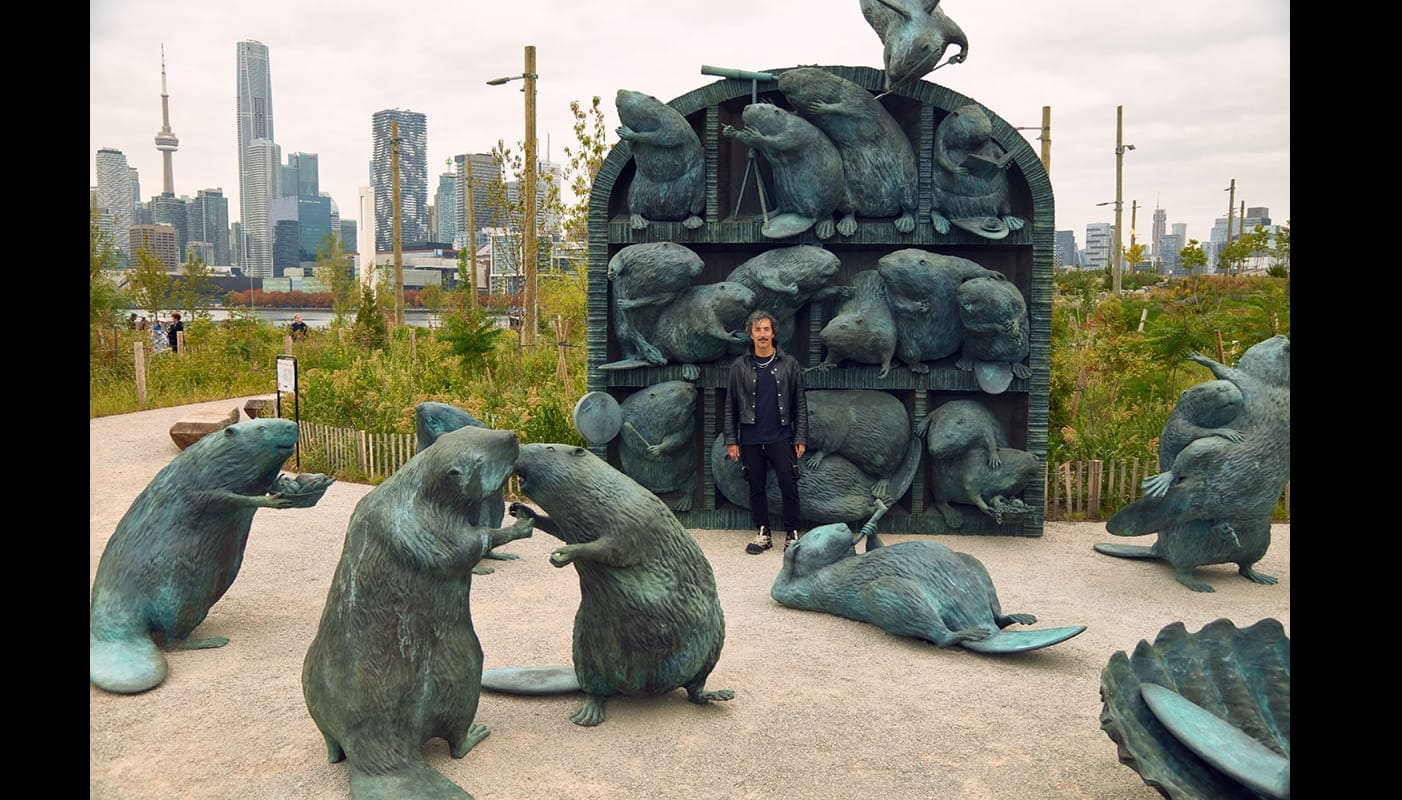
Standing more than 15 feet tall and cast in bronze with a verdigris patina, The Colony depicts a larger-than-life family of beavers feasting, singing, dancing, and celebrating together. The scale is deliberate: the sculpture nods to mistahi-amiskwak, the giant beavers of traditional Cree storytelling, as well as to Castoroides, the actual giant beaver species that roamed North America during the Pleistocene era.
18th Century Italian Engraving Reimagined Through an Indigenous Lens
Monkman said the piece draws inspiration from an 18th-century engraving by Italian artist Veremondo Rossi, reimagined through an Indigenous lens and placed at a site rich with meaning. “It feels especially meaningful for The Colony to be placed here, where the Don River — home and important waterway for the Wendat, Haudenosaunee, Anishinaabe, Mississaugas, and other Nations for thousands of years — meets Lake Ontario,” Monkman said. “I can’t think of a better place for these beavers, inspired by the fanciful beavers of Veremondo Rossi’s 18th-century engraving, to gather in a ceremonial feast, celebrating our worldviews, honouring the water, and continuing our traditions of relaying knowledge through songs and stories.”
The verdigris finish is itself a nod to 19th-century sculptural tradition and the idea of permanence — a fitting choice for a piece meant to anchor the park for generations.
The Weight of the Beaver
Beneath the playfulness, The Colony carries a pointed historical parallel. According to LAT, beavers once numbered in the hundreds of millions across the continent before colonial commercial and political competition drove their population down to roughly 100,000 — a collapse the organization draws an explicit line to the genocide that decimated Indigenous populations across Turtle Island over the same period.
Today, beaver populations have rebounded, and LAT frames the sculpture as an invitation for them — and by extension, the histories and knowledges they represent — to reassert their presence. “In this reclaimed land on the shores of Lake Ontario, The Colony honours the beaver and invites them to once again assert their presence, share their knowledge, and help restore our ecosystems,” the organization said in its announcement.
The sculpture’s placement wasn’t left to chance either. It sits near where the newly re-engineered mouth of the Don River meets Lake Ontario, and visitors are encouraged to walk through and around the piece, taking it in from multiple angles rather than viewing it as a static monument.
Why Truth and Reconciliation Day Matters Here
Landing the unveiling on September 30 connects The Colony to a broader civic moment happening across the country. The National Day for Truth and Reconciliation was established following the 2015 Truth and Reconciliation Commission’s calls to action, as a day for Canadians to reflect on the history and ongoing impact of residential schools and to honour survivors, their families, and communities.
Public art that centres Indigenous artists, worldviews, and histories — permanently, and in one of the city’s most visible new public spaces — is exactly the kind of gesture the day is meant to encourage: not a one-day acknowledgment, but something durable that stays in the landscape long after September 30 has passed. Monkman, one of the most prominent Indigenous artists working today, has built much of his career around confronting colonial narratives through his work, and The Colony continues that project in a new, monumental form — one that will be seen by the millions of people expected to pass through Biidaasige Park in the years ahead.
A Cornerstone of a Much Bigger Trail
The Colony is one of two permanent “destination” sculptures planned to anchor the Lassonde Art Trail long-term. Once complete, it will be gifted to the City of Toronto’s Public Art and Monuments Collection. The second permanent piece, by internationally renowned Portuguese artist Joana Vasconcelos, is slated to join the trail in 2027.
With The Colony’s addition, the Art Trail now comprises 17 sculptures in total, 11 of which were newly commissioned specifically in dialogue with the site. The launch program also features work from Monira Al Qadiri, Alexandre Arrechea, Nadia Belerique & Tony Romano, Tracey Emin, Ryan Gander, Kara Hamilton, Alexa Kumiko Hatanaka, Lisa Hirmer, Caroline Monnet & Dean Baldwin Lew, Oluseye, Virginia Overton, and Hank Willis Thomas.
Lassonde Art Trail executive director Chloë Catán called the sculpture a milestone for the young organization. “The Colony is a truly spectacular and masterful sculpture that will bring joy and meaning to all who visit Biidaasige Park,” Catán said. “It was an honour to work with Kent Monkman and his team to bring it to life on the Lassonde Art Trail. The Colony will undoubtedly become one of the most beloved destinations in Toronto.”
Philanthropists Pierre and Julie Lassonde, whose $25 million founding gift helped establish the trail’s two permanent landmark commissions, described commissioning Monkman’s first public artwork as “an extraordinary privilege.” Said the Lassondes: “As a permanent cornerstone of the Lassonde Art Trail, it ensures his iconic artwork is freely accessible to the millions of visitors who will walk these grounds for generations to come.”
Part of a Bigger Waterfront Story
The Lassonde Art Trail sits inside Biidaasige Park — Toronto’s largest new park in a generation — part of a $1.4 billion tri-government revitalization of the city’s eastern waterfront led by Waterfront Toronto. The project has reshaped the area through flood protection, ecological restoration, and new public space, with future mixed-use residential communities also planned for the area.
George Zegarac, President and CEO of Waterfront Toronto, tied the sculpture directly into that larger mission. “The foundation for our generational transformation of the Port Lands is ecological restoration, resilience, and world-class public spaces,” Zegarac said. “Kent Monkman’s The Colony builds on that vision, creating new opportunities for people to connect with nature, water and the histories that have shaped this place for generations.”
The City of Toronto, which will steward the piece once it’s formally gifted, echoed that sentiment. “We are honoured to become the steward of Kent Monkman’s first public sculpture, a landmark work that will enrich Biidaasige Park and invite generations of residents to engage with world-class art in one of Toronto’s most dynamic public spaces,” said Aderonke Akande, the city’s Director of Arts and Culture Services.
Visiting The Colony
The Lassonde Art Trail spans more than four kilometres of walking paths through Biidaasige Park on Ookwemin Minising, the new island in Toronto’s harbour, at 39 Commissioners St. Like the rest of the trail, The Colony is free and open to the public year-round.
For more information or to sign up for the Art Trail’s newsletter, visit latfoundation.org or follow along at @thelatfoundation.
feature photo Kent Monkman with The Colony. 2026. Bronze, steel. Commissioned by Lassonde Art Trail. photo by Michael Seleski